Category Archives: Pets of the Old Republic

POTOR Raffle

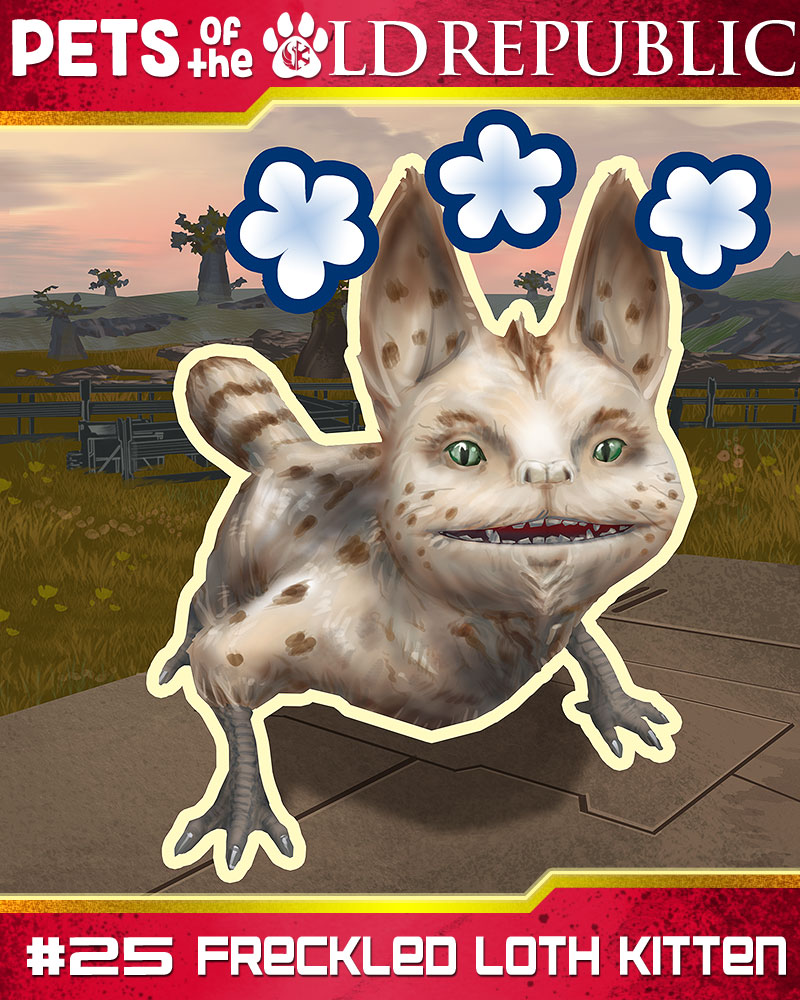
Pets of the Old Republic will soon reach its 25th installment.  I am proud of my work on this project. It was great fun to research, illustrate and write each entry. Therefore, I feel like it is a great time to end of this project with a raffle open to players of Star Wars: The Old Republic.

To enter this raffle, all you need to do is guess what the last pet, #25, will be! You don’t need to guess correctly to be eligible to win, anyone who enters will have a chance at a prize.
I can say it will be a variety of creature which I have not yet covered in this series. For example, since the Opal Vulptilla was Pet #1, the final pet will NOT be either the Amethyst or blue Vulptilla puppies. Feel free to check out the previous pets in this series to narrow your choice down.

I will select 10 winners who will have their choice of either 450 Cartel Coins OR 30 days of SWTOR subscription time. The first person to pick the correct pet will receive BOTH!

Here are the full rules:

To enter, leave a comment below this post with the following information:

  • Your character name (be mindful of spaces and special symbols!)
  • Your faction
  • Your server
  • Which prize you prefer to win: 450 cartel coins or 30 days of SWTOR subscription time

That’s it! I will accept entries for one week from this posting and will randomly select the winners on December 19 at 6 PM ET. I will send prizes through SWTOR’s in game mail to the character name in your entry.

If you prefer not to comment publicly, I will also accept entries via email at twia@generic-hero.com or through Bluesky.

There are no country or server restrictions on any of the prizes that will be awarded.

This giveaway is not sponsored, endorsed or administered by, or associated with LucasFilm Ltd, Broadsword or Electronic Arts Inc.

We’re on the honor system here, so one entry per person, please.

Good luck and may the pets be with you!


16 Comments

Filed under General SWTOR, Pets of the Old Republic

Pets of the Old Republic: #24: Kowakian Monkey Lizard

This installment of Pets of the Old Republic features the most famous pet in all of Star Wars lore, even if it may not actually be a pet: the Kowakian Monkey-Lizard! There are several varieties of monkey-lizards available to players of Star Wars: The Old Republic, but in honor of the yuletide season, I picked the jolliest and reddest of them all: the Ruddyscale Kowakian Monkey-Lizard.

There are six very different monkey-lizards currently available for players to collect. They be found with different colored fur, with cybernetics, carbon-frozen or even zombified. The Ruddyscale was introduced in the Cartel Market, but these days players of Hero rank with the Underworld Exchange reputation track, can purchase it for 100,000 credits and 10 Cartel Market Certificates from one of the Underworld Exchange vendors in either Fleet’s Cartel Bazaar.

A troop of Kowakian Monkey-Lizards (clockwise from the left: Carbon-Frozen, Sablefur, Cyborg Sablefur, Flamehair, Ruddyscale and Plaguetail), confront a chef who seems to have over-cooked some of their kin.

In the interest of honesty I must admit that I did not include a monkey-lizard on my original list of pets to include in this project. The monkey-lizard is one the older pets I’ve studied as part of this project, and in comparison to many of the recent pets we’ve seen, it hasn’t aged well. However monkey-lizards, tied with Dwedtoof, were the most requested pet for me to illustrate for this project. Even though I put it off to very nearly the end, never let it be said that I did not give the people what they want.

I’m glad I did. SWTOR’s depiction of the monkey-lizard has a ton of charm with an expressive face and signature cackling laughter. If someone in your group is adventuring with a monkey-lizard, everyone will hear its mirth clear as day, as well they should. Nevertheless, the SWTOR team has shown a willingness to revisit some older assets in the game, and I would not object if they decided to update one of Star Wars’ classic little buddies.

Salacious B. Crumb, moments before Jabba’s sail barge exploded.

The most famous monkey-lizard in Star Wars is Salacious B. Crumb, the companion of the vile gangster Jabba the Hutt from Return of the Jedi. This fellow not only merits a first and last name, but is the one of only two live-action Star Wars characters with a middle initial.

During the production of Return of the Jedi, aliens were often given humorous names by Industrial Light and Magic’s creature designers. The first name “Salacious” was derived from a drunkenly slurred pronunciation of the word “shoelaces” and the last name came from George Lucas after the underground cartoonist Robert Crumb, known as simply R. Crumb. Crumb’s comix are often infamously obsessed with exaggerated depictions of women, and the creature’s mocking laughter and leering presence likely connects the names Salacious and Crumb.

The question of whether Kowakian Monkey-Lizards are intelligent is not clearly addressed by Salacious’ portrayal in Return of the Jedi. Wookieepedia describes them as “semi-intelligent” which seems to me like dodging the question. Salacious’ puppeteer, Tim Rose, gave him a speaking voice which we can hear in the movie’s supplementary material, so I think it’s fair to say he is intended to be an intelligent life-form and not simply an animal. Numerous depictions in other Star Wars lore reinforce this interpretation of monkey-lizards as intelligent as any other alien species in the galaxy.

However, I should point out that in The Mandalorian and even in SWTOR, Monkey-Lizards are regarded as food in some corners of the galaxy. Personally I don’t consider it ethical to eat a monkey-lizard, but I’m sure there are plenty of folks out there, probably starting with many of the Hutts we have met who wouldn’t think twice about it.

Salacious B. Crumb and the monkey-lizards as seen in SWTOR fit within a larger culture traditions that are worth mentioning. They are the court jesters of the Star Wars universe. Jesters and Fools can be found across the history of our own world. Jesters were known as entertainers and musicians and had a prominent position in court because they would laugh at the king’s jokes and laugh at the king’s subjects.

The cultural significance of monkeys is far too broad a topic to cover here, but monkey companions are extremely common in all sorts of stories including but not limited to Tarzan media, the Ronald Reagan comedy Bedtime for Bonzo, the Flying Monkeys of The Wizard of Oz, Abu from the animated Aladdin movies, Marcel from Friends, Boots from Dora the Explorer and many, many more. Monkey-lizards fit perfectly within the role of “pets” rather than “companions” for our characters in SWTOR. Even though I do not think of them as animals, they, like many bards, escape notice in a firefight simply for being not important enough to kill in the heat of battle.

The monkey-lizard’s design reflects this history. As with nearly every pet in this series, they are a hybrid of many types of animals. Its long tail and body type are unmistakably simian, but I don’t actually see much lizard in the creature’s design. The monkey-lizard’s long pointed ears remind me very much of a jester’s cap with points sticking straight out from the side of the head. Instead of a mouth, Monkey-lizards have a broad sharp beak like a vulture, a creature whose reputation as a scavenger seems appropriate for Jabba’s nasty little sidekick.

Salacious’ big mouth and comic relief status reminded many people of the Muppets who, thanks to their TV show and series of movies, were very popular at the time of the original trilogy. Muppets and Star Wars intersected in many places at this time; Frank Oz performed both Yoda and many Muppets including Miss Piggy and Fozzie Bear. ILM’s creature designers were influenced by what Jim Henson was doing both with the Muppets and also the fantastic creatures created for Henson and Oz’s movie the Dark Crystal. I also believe Salacious influenced the creatures seen in the movie Gremlins, both the friendly Gizmo and the mischievous Stripe.

Imagine being a Star Wars fan who hates Wicket W. Warwick, Salacious B. Crumb and Max Frickin’ Rebo.

In time, however, serious minded fans came to dislike these similarities. Even though the original trilogy now occupies a rarified space in the canon of Star Wars films, hipsters of the 1990’s criticized Return of the Jedi with the same fury and opprobrium that some of today’s fans reserve for many modern Star Wars productions. I’ve always felt that this rage was misplaced, and this project is proof that I enjoy the sillier and weird side of Star Wars. If I’m being honest, I don’t think there is anything wrong with The Phantom Menace or The Clone Wars cartoons or The Rise of Skywalker that isn’t also wrong with Return of the Jedi. So, yeah, if you ask me, we all could stand to have a monkey-lizard around to laugh at us and keep us honest when we start taking things too seriously.


1 Comment

Filed under General Star Wars, General SWTOR, My Artwork, Pets of the Old Republic

Pets of the Old Republic: #23: Gree Data Core

This installment of Pets of the Old Republic features the third and final droid to appear in this series. I feel like I should’ve featured more droids given their importance in Star Wars history, so should I return to this project, I’ll be sure to expand their numbers. For today, however, let’s take a good look at another one of my favorites: the Gree Data Core.

The Gree Data Core is, at first glance,  simply a hovering cube. It shares design elements with other Gree technology players encounter on during their testing on Ilum, in the Operation Terror from Beyond and the Ancient Hypergate, PVP Warzone. The Core is one of four pets players can collect from the “Relic of the Gree” Event, Star Wars: The Old Republic’s very first recurring event, and one that is still a favorite of mine whenever it comes around. Players can purchase this pet once they achieve the Reputation rank of Newcomer with the Gree Enclave; a level that can be achieved the first week players participate in the event.

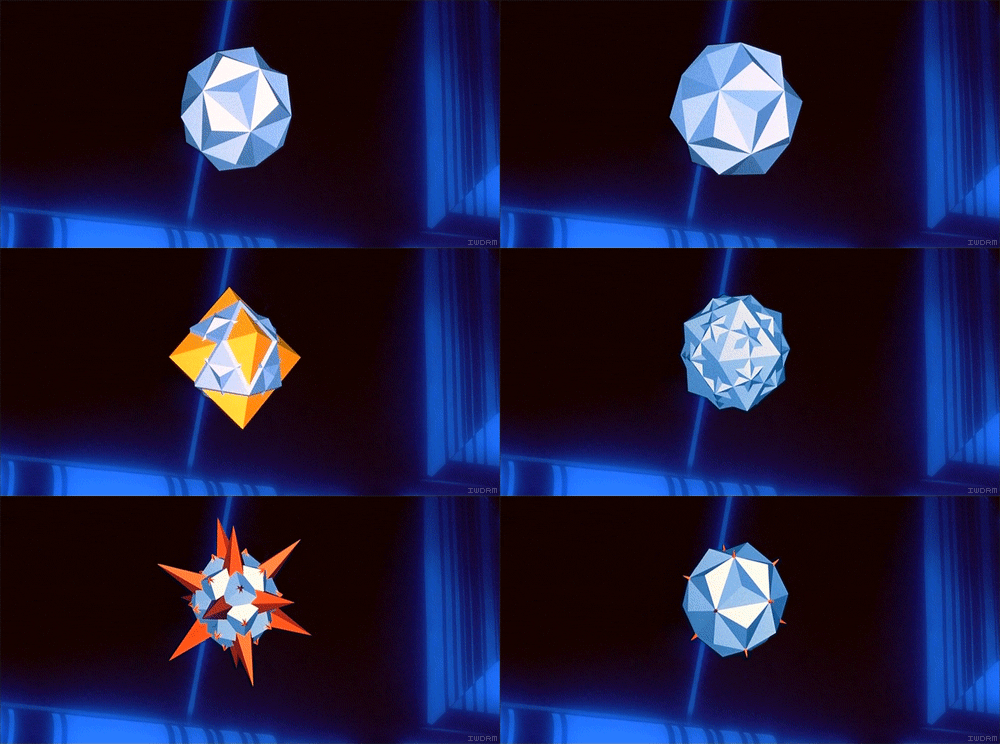
A Bit program from Tron can respond with only two states: positive or negative.

I’ve always been fond of the Gree aesthetic for the simple reason that as a child of the 1980s, I thought the movie Tron was cool. By today’s standards, the film’s story is slight, and its once groundbreaking special effects seem rather quaint. I was taken by its neon soaked glow, its terrific electronic musical score, and the fact that it very presciently asked at the start of the internet age who should have access and control of the online world. Finally, it explores the question of how much of ourselves we put into the things we create, a question as old as art itself. And, to be clear, Light Cycles are totally rad.

The first published depiction of the Gree by artist Christian Gossett from the article “The Gree Enclave”.

The Gree made their first appearance in 1995 during the early days of the Expanded Universe in an article written by Timothy O’Brien for West End Games’ Star Wars Roleplaying Game. The Gree have been mentioned here and there in subsequent Star Wars lore, but they’ve appeared most prominently in SWTOR. Many aspects of the Gree that players will recognize from our interactions with them, such as the planet Asation, their extensive use of Hypergates and their interest in maintaining ancient technologies come straight from O’Brien’s writing. The Gree’s distinct neon-piped technology and the color and geometry based metaphors that fill their speech patterns are additions to their lore from their roles in SWTOR.

Portal‘s Weighted Companion Cube really isn’t much of a companion.

I should mention the Gree Data Core’s two most obvious inspirations. The first is the Bit from Tron. The Bit is a small, polyhedral, floating shape that can only communicate using Yes or No answers. They also float above the ground and accompany more complicated programs or users across the Game Grid, much like the Gree pet in SWTOR

However, the Data Core closely resembles the Weighted Companion Cube from the acclaimed video games Portal and Portal 2. Portal is about traversing spaces using technology that resembles Gree Hypergates, so it is reasonable to believe that the Gree would be fans as the game as well. Unlike the Gree Data Core, the Companion Cube is inconveniently immobile and seemingly uninterested in accompanying anyone on their adventures.

A collection of cubes: B1-SAL Probe Droid, Gree Data Core, BX-23 Probe Droid, BX-24 Probe Droid, P1-XL Probe Droid, B25-Sal Probe Droid.

Curiously, cube-shaped pets are very common in SWTOR. In recent years, the game has awarded five more to players as login promotions. The first of these pets was inspired by the infamous “orange pixel” bug from the very, very early days of SWTOR, and contains in its design elements of other droids from across Star Wars lore. The two most recent cubic airborne droids are cousins of the beloved, sad sack droid B2EMO from Andor.

Listen to the Gree speech patterns long enough and it starts to make sense!

Currently, the Gree Data Core is only cube pet available to players, so I highly recommend checking out the Gree Event next time it comes around on Ilum. After that, definitely take time to raid the Terror from Beyond, one of my favorite SWTOR operations. When leveling up a player on the Republic side, also make sure to earn the title “Black Bisector” from the Gree side quest on Coruscant. The player’s interactions with the Gree Operators assisting the reconstruction of Coruscant are both amusing and a good introduction to the Gree’s culture and distinctive dialect.


Leave a Comment

Filed under General Star Wars, General SWTOR, My Artwork, Pets of the Old Republic

Pets of the Old Republic: #22: Earthen Thurrb

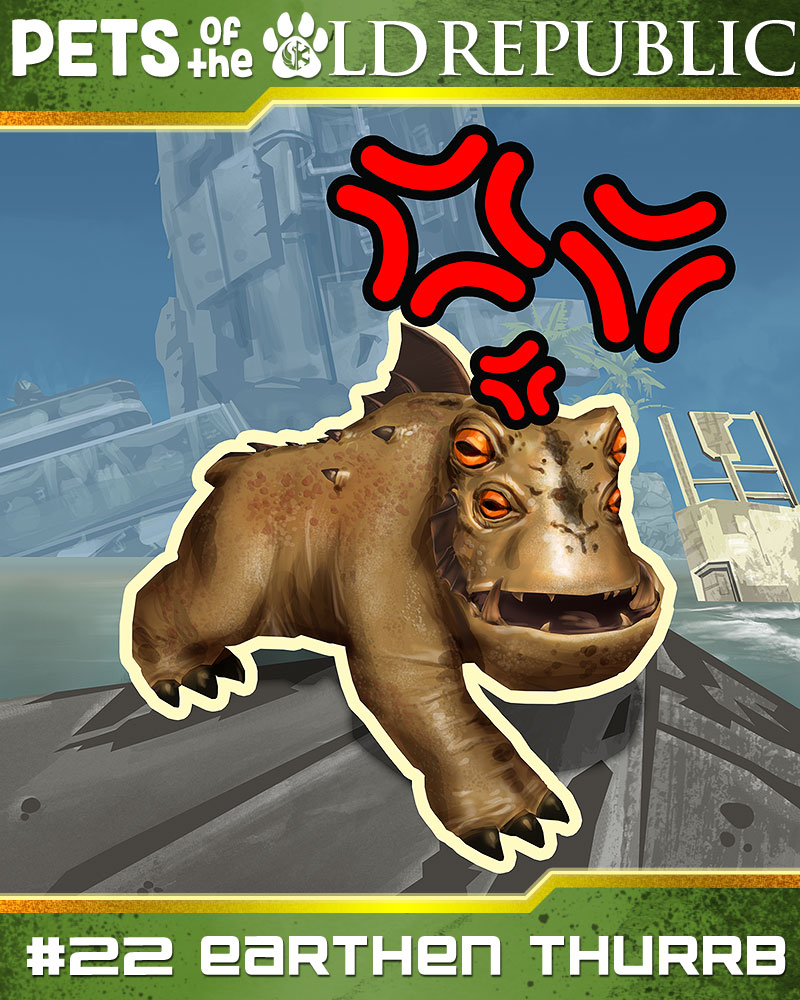
This installment of Pets of the Old Republic features a creature not with too few eyes but a pet with too many: the Earthen Thurrb. This is one of the most distinctive pets in Star Wars: The Old Republic. This baby Thumb and its grown up kin are found, for now at least, only in SWTOR.

In the game, the source of the Thurrb pet is the harvest themed Feast of Prosperity event, and had I kept to my original schedule for this project, this entry would have appeared while the Feast was still active. If you have leftover Feast tokens, you can still purchase this pet from the Feast vendor on Nar Shaddaa. Even if you have to wait until next year, it is worthwhile to highlight pets that are available from the game’s many factions and events.

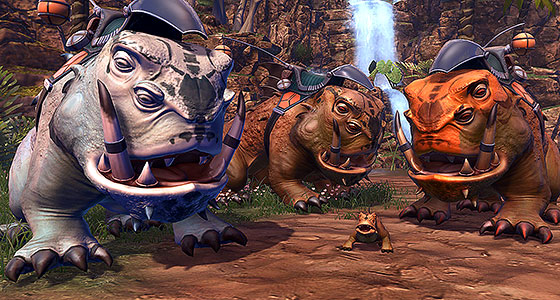
As of this writing there is not much information known about Thurrbs, but I think I can conclude a few things from the pet itself as well as the three Thurrb mounts. Two of the three existing Thurrb mounts were found on the second Galactic Season reward track and for the moment are otherwise unavailable to new players, but the third, the Conflagrant Thurrb is available from the “Classic and Non-Seasonal Rewards” vendor as part of their rotating offerings past Season rewards.

Adult Brumal, Tellurian and Conflagrant Thumbs keep watch over a tiny Earthen Thumb while explaining the value of a strong vocabulary.

Because of their colorful hides and names, we can assume that Thurrbs thrive in many diverse habitats from fiery hot to wintery cold and everything in between. Thurrbs are mammals but based on their frog-like faces and fish-like fins and ears, seem to be adapted to thrive in aquatic environments and might even be amphibious.

At this point in this series, it should not surprise anyone to learn that Thurrbs are inspired by all sorts of creatures whose parts combine into a unique whole. Fully-grown Thurrbs have massive tusks like a walrus, eyes like frogs, and the cavernous mouth, the thick hide and hefty frame of a hippopotamus. Unlike hippos, which are aggressive and dangerous to humans, one fact we know about Thurrbs is that they have a much milder temperament.

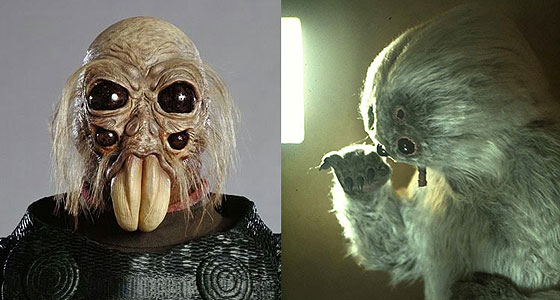
It’s hard to maintain eye contact with the prequel era Aqualish and the original trilogy Talz when you don’t know which eyes to look into.

The first thing you might notice about a Thurrb, however, are its four eyes. While creatures with a single eye are somewhat rare in Star Wars, aliens with four are remarkably common. During this very project, I have already covered the quadruple eyed Ginx, the Mewvorr and the Nexu. That’s just the tip of the iceberg of four-eyed aliens in Star Wars lore. Other examples include the Lisk found on Ilum, some species of Aqualish, and the Talz which was first seen in the cantina scene of A New Hope and will be familiar to SWTOR players from the Sith Warrior’s companion Broonmark. It makes sense that strange monsters with extra eyeballs are common in Star Wars. Extra eyes immediately make a creature into a literal “bug eyed alien” and mark it as something very far outside our usual frame of reference.

I want to conclude with some remarks about how the Thurrb was introduced and discuss how the game’s approach to pets are has changed over the years. The large majority of pets featured in this project were created specifically for Star Wars: The Old Republic. I think this speaks to the goal of the game’s developers to tell stories not just within Star Wars’ existing setting, but to add to it and create worlds and characters and creatures all their own. Certainly much of the fun of SWTOR is getting to dig in the Star Wars sandbox and play with the toys we recognize from its lore, but a big part of what makes the game so memorable to me are the people, places and things we’ve never seen before.

The Curious Rodir Cub is another unique pet that debuted during the Feast of Prosperity.

The Thurrb is one of those. It was introduced first as an adorable and silly pet, and reappeared in a different context as a full sized creature we can ride across the galaxy. Many (but not all) of SWTOR’s original pets were simply miniature versions of their fully-grown counterparts, but in recent years, extra care has been given to the detail and texture of the pet models to make them both cute as babies and distinct from their adult versions. We can see this with other pets such as the Rodir, the Varactyl, the Pritarr and many more.

As for pets inspired by other Star Wars stories, I’m all for adding those too. My unsuccessful years-long campaign to get SWTOR to add a Porg pet is proof of that! But I will never object to seeing something unexpected and fresh, and I look forward to seeing what tiny robots and cuddly critters they can come up with next.


4 Comments

Filed under General Star Wars, General SWTOR, My Artwork, Pets of the Old Republic

Pets of the Old Republic: #21: Devious Creep

Halloween is the perfect holiday to inspire me to explore another spooky and weird corner of Star Wars: The Old Republic with a pet whose name literally says it all: the Devious Creep! The Creep is part of a class of pets like the Mischievous Miniprobe, whose name is entirely descriptive and does not clarify what kind of creature it is or where it comes from. We know nothing else at all about this strange, alien imp beyond its appearance and epithet.

Is this a larval form of an adult monster? Is it related to other creatures or species from SWTOR or Star Wars in general? Is it a creep like someone who leaves inappropriate voice mails or a creep like something that lurks in the shadows? Is it both? And what do you mean it’s devious? Is it plotting against me?

Nobody knows! And here’s the thing, I’m not sure I want to know. In fact, yes, I am certain, I do not want to know. This thing is nightmare fuel, and learning anything more about it can only make it worse. The tooltip players click to summon this pet refers to it as a Blurrg, which it clearly is not. The pet’s model does seem to use the same skeleton as a Blurrg, and this reference may simply be a placeholder that was never corrected. This oversight suggests to me that even the devs refuse to name this beast! I don’t blame them.

Against my better judgment, let’s take a close look at the Creep. It has long, sharp, hooked horns that frame what seems to be a vertically aligned mouth, two large tusks for holding its prey, and two tiny teeth at the base of its mouth for tearing flesh. It just gets ickier. Those two chonky legs suggest it can run fast in a pinch, and its armored carapace means it can take a beating after it has clamped down on its next meal.

And what are those yellow things on the Creep’s back? If it’s an armored braincase, it might explain how it got so devious. But I fear they might be coverings for wings like we see on a flying beetles. The notion that these things can fly just makes it so much worse.

However, the Devious Creep’s most prominent feature is, of course, its single, large glowing eye. Like small cats and snakes, the Creep has an eyeball with a long vertical pupil, which indicates that it is an ambush predator. The fact that the Creep’s large eye glows with yellow malice seems to me that it really doesn’t care if you see it coming. At the first sight of that peeper, you really should start running or pull out a flame thrower.

An Abyssin cowers in the tomb of Naga Shadow on Korriban.

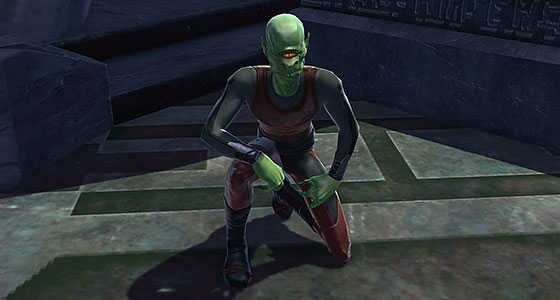
Aliens and creatures with a single eye, are relatively rare in Star Wars lore, but the two most prominent cyclopic examples can be encountered in SWTOR. The first is an Abyssin, an alien race that appeared in the cantina scene in Star Wars: A New Hope. Aside from the trait of having just one eye, the Creep and the Abyssin seem to share little else in common.

This Baby Dianoga has found its way into the kitchen of Bog’s Bounty Banquet Hall and is hoping to snatch up a scrap or two.

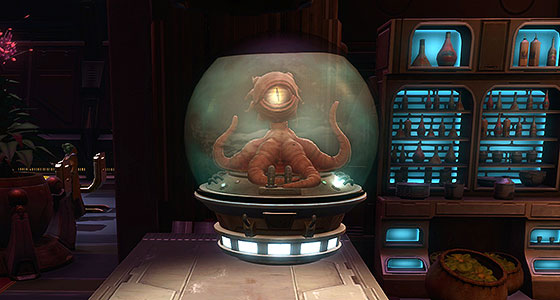
The Creep’s eye is similar in shape and color to the most well known single-eyed creature in Star Wars: the Dianoga, the tentacled monster encountered by Han, Luke, Leia and Chewie in the garbage masher scene in A New Hope. The eye of the Dianoga is only the tip of its much larger octopus-like body, so the Creep doesn’t seem closely related to the famous alien cephalopod either. However, I agree with Luke Skywalker’s assessment that shooting either of these ravenous creatures “Anywhere!” is an appropriate response to an unwanted encounter with them.

“Once you name it, you start getting attached to it!”

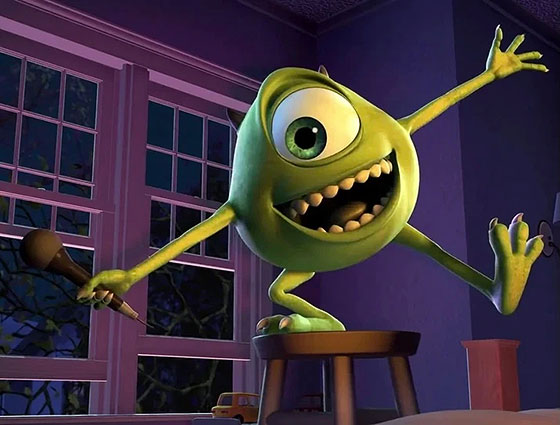
The one positive point in favor of the Creep is its similarity to creatures from a different franchise of Disney movies. If you told me that the Devious Creep was the bad seed cousin of Mike Wazowski from Monsters, Inc., I would not doubt it. If that is the case, then the Creep is likely extremely good at inspiring nightmares in small children. Probably too good.

Finally, the source of the Devious Creep pet is SWTOR’s Cartel Market. The pet has only been available for sale for short periods of time, often around Halloween. Players looking to acquire this pet will have to check the Galactic Trade Network. Because of its rarity, the Creep tends to be one of the most expensive pets for sale. In my research, I discovered that on the Star Forge server, there was only one Creep listed for the cool price of a half billion credits. I shall let you decide if that’s worth it to you.

I cannot deny its distinctive, yet disturbing appearance makes the Devious Creep one of the most unique and mysterious pets in the game. My Sith Inquisitor loves it dearly, but knows full well that this nasty little incubus probably does not love her back.


4 Comments

Filed under General Star Wars, General SWTOR, My Artwork, Pets of the Old Republic

Pets of the Old Republic: #20: Flirron

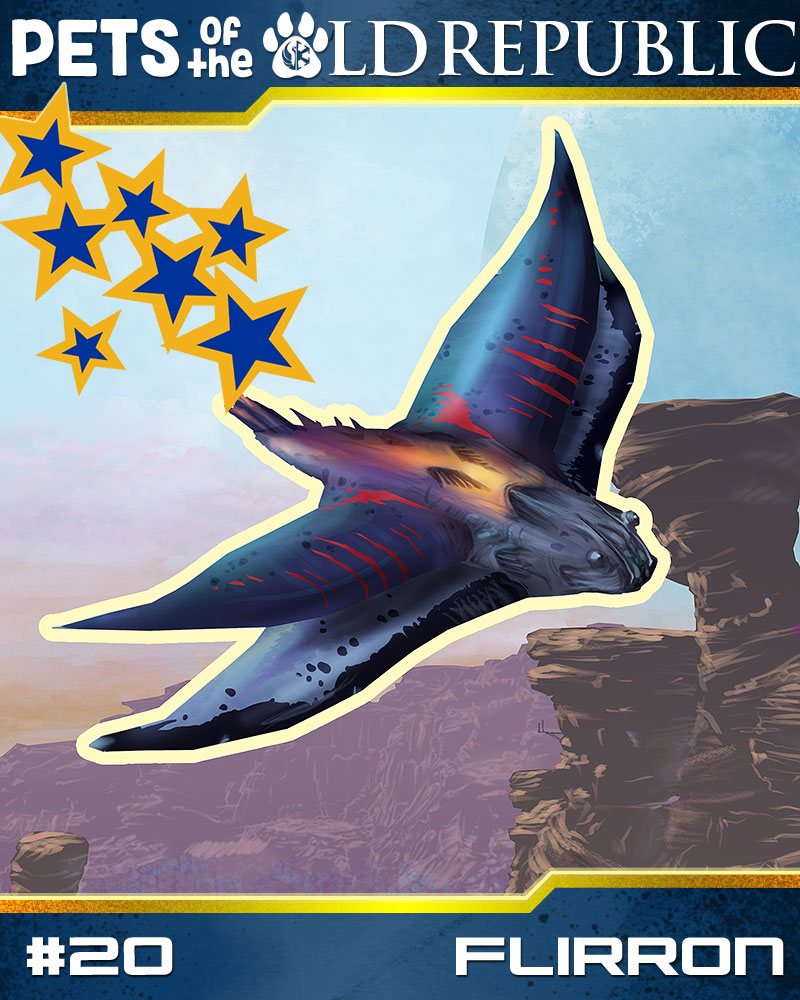
The next creature to be featured in my Pets of the Old Republic project is the tiny and hungry Flirron. Flirrons are native to the planet Onderon where players may encounter them in the wild and ride them as taxis to and from the jungle world’s questing areas during the Onslaught expansion of Star Wars: The Old Republic.

Players whose characters are high enough level to survive the dangerous jungles of Onderon may acquire the Flirron as a pet. The Flirron won’t cost you a single cartel coin or credit, nor does it have any reputation requirement. The Flirron pet is automatically awarded via an achievement which has you locate morsels of food to feed the tiny Flirron fry found in the zone. Like many a lost kitten, feed it enough and it will follow you home and assume you’re its momma.

While researching this entry, I consulted several guides for unlocking this achievement and discovered when I had unlocked the  Flirron, I had done it wrong, or least extremely inefficiently. I had thought you had to feed twenty-five Flirrons one morsel each, but it turns out you can instead stuff one Flirron to the gills twenty-five times. My approach took just a little longer!

Onderon is a world rich in history from across Star Wars lore, from the Old Republic comic books of the 1990s to the animated and live action shows and movies of today. Despite this, everything we know about Flirrons comes from a single codex entry players receive when they first encounter one. There isn’t much information to go on, but I think I can fairly draw some further conclusions from the Flirron’s physiognomy and similarities to other similar creatures we encounter in SWTOR.

Suspended by the warm air currents generated by Belsavis’ tropical geothermal rifts, a four-winged, Marlin-like Baspoor soars along the edge of a small lake.

Despite what it says on Wookieepedia, Flirrons do not have feathers and I would not characterize them as Avians. As with nearly every other critter we’ve looked at for this project, the Flirron is instead a hybrid of many types of creatures. At first glance, it’d be easy to simply describe them as literal flying fish. Upon closer examination, we can see that they are part crustacean, part cephalopod and only a small part fish. Starting at the front, a Flirron has the face of a shrimp, a double pair of wings like a Baspoor from Belsavis, the body of a cuttlefish and the dorsal and tail fins of a ray-finned fish.

Flirron seem to share the most properties with cuttlefish perhaps starting with how they move through their respective environments of air and water. Cuttlefish suck in and expel water as a means of propulsion, so I think we can conclude that Flirron’s move through the air in a similar, albeit scientifically nonsensical, manner. Like the Thrantas we encounter on Alderaan, I imagine that Flirrons maintain natural “buoyancy” in the air through chambers that contain lighter than air gasses in their bodies or wings.

A Thranta dives into the Glarus River Valley. As long as you’re not in a hurry, the sky-sharks of Alderaan are a stylish way to travel.

Am I saying that Flirrons are filled with explosive hydrogen gas and can maneuver like a jet fighter? Let’s just say I’m NOT not saying it. But it could go a long way to explain how a creature that is said to be so gentle thrives among the fierce fauna that stalks the jungles of Onderon.

Flirrons are notable for their colorful, iridescent skin which is filled with billions of chromatophores. Flirrons may change color as a form of communication, but this property also makes them a wonder to behold. Flirron watching is a pastime for both locals and tourists on Onderon. I suspect this aspect of Flirron lore may have been inspired by a similar popular activity of watching thousands of bats emerge from the Congress Avenue Bridge in Austin, Texas, home of much of SWTOR’s development team. I’ve seen this amazing swarm take flight myself and I imagine the spectacle of a school of color-shifting Flirrons caught in the shimmering light of a hazy Onderon sunset would be breathtaking to behold.

I’ve often said that exploration is one of my favorite parts of the MMO-RPG experience, and the achievement to adopt a Flirron is a great way to simply exist in the game’s world for a while and also come away with one of the most distinctive pets in the game.


2 Comments

Filed under General SWTOR, My Artwork, Onslaught, Pets of the Old Republic

Pets of the Old Republic: #19: Nefarious Blurrg

From the very start, the Nefarious Blurrg was guaranteed a place in this project. It has long been one of my favorite pets in Star Wars: The Old Republic and was certainly the first Cartel Market pet I unlocked for use across my account. Blurrg pets come in many varieties, but this one’s striking red, scaly hide and black stripes draw attention and let you know even before seeing its name that it is the most nefarious of the bunch.

A big part of the fun of this project for me has been exploring the origins of these pets and seeing how they are connected to other creatures both real and imagined. To my surprise, the Blurrg has put down footprints in every little era of Star Wars‘ lore. To most Star Wars fans, Blurrgs are familiar as the surly lizard mounts ridden by Din Djarin and the Ugnaught Kuiil in the very first episode of The Mandalorian, but a Blurrg pet appeared in SWTOR seven year earlier, and fans of the Clone Wars cartoon will recognized the use of Blurrg mounts in an episode three years before that in 2009.

A production illustration of Blurrgs at home on the range from The Mandalorian.

The origins of Blurrg’s stretch even farther back into Star Wars history to the early days of The Empire’s Strikes Back’s development in the late 1970s, with a few more stops along the way.

What we now call as a Blurrg had its start in the creation of the creatures that eventually became Tauntauns in Episode 5. It’s obvious if you compare them side by side. Both have long tails, Tyrannosaurus-like bodies, with sturdy back legs and teeny tiny forearms. During Empire’s development, Industrial Light and Magic’s artists, creature designers and animators explored the possibility of the mounts used by the Rebels as being lizards rather than the more mammalian Tauntauns eventually seen on screen.

Creature design for The Empire Strikes Back that inspired the Blurrg.

The original design must have struck a chord with someone at ILM because in 1985, this design was revisited and reused for the movie Ewoks: The Battle for Endor. The creatures seen in this TV movie were brought to life in delightful stop motion animation and remain recognizable as the Blurrgs we see in Star Wars today.

The stop-motion animated pack animal from Ewoks: The Battle for Endor.

It’s interesting to reflect back on a time after the conclusion of the original trilogy when the Star Wars franchise was most prominently carried by the Ewoks, who starred in their own comic books, Saturday morning cartoons and television movies. This media was definitely aimed at children rather than adults or even teenage fans, was clearly made with a limited budget, and not lacking at all in cheese, but it does serve as a reminder that Star Wars doesn’t have to be completely serious all the time.

In 1995, during the heyday of the Expanded Universe, the creatures were formally identified as Blurrgs in the book, The Illustrated Star Wars Universe. This book is a travel guide of the major worlds seen in the Star Wars films, and I imagine the creature’s name is meant to be indicative of its call or moo. Curiously the illustration of the Blurrg used in the book seems to have been an early design that does not match what was seen in the movie. The book’s depiction of the Blurrg was later adapted for use in Star Wars Galaxies, Star Wars’ first MMO-RPG.

Blurrgs as we now know them found their place in modern Star Wars lore in the Clone Wars and later Star Wars: Rebels animated series before finally returning to their live action roots in The Mandalorian. They have the bodies of a dinosaur, the clompy feet of a rhinoceros, and the full, furious face of a fish. They are ridiculous, but I think that is a big part of their charm. As we have seen many times, they are hybrids of different animals, but in a final form that any kid can instantly understand. Yeah, you can ride them like horses, but they’re probably not going to be happy about it!

Many Blurrgs (left to right): Speckled, Hooded, Lurker, Striped, Nefarious, Mottled, Sublime and Mossrankle Blurrgs.

In SWTOR, Blurrgs only exist as pets. There are no full-sized adults to encounter in the wild nor mounts that players can ride. Still, there is a wide variety of Blurrg pets to collect in colors certain to match any player’s fancy. With the exception of the Umbral Blurrg, a retired pet included with a Cartel Coin promotion, all Blurrg pets came from the Cartel Market, and, for the most part, remain reasonably priced on the Galactic Trade Network. As I write this, the Mossrankle Blurrg is currently available for purchase from the limited time Subscriber Token Vendor, but I recommend collectors check the auction house before spending the more precious tokens on a pet.

Should you adopt a Blurrg of your own? Some pets adore their owners. Some are as loyal as the day is long. Some bring joy after a long, hard day. The Nefarious Blurrg follows us reluctantly and silently judges our every move. Sometimes we all could use a little bit of that in our lives.


1 Comment

Filed under General Star Wars, General SWTOR, My Artwork, Pets of the Old Republic

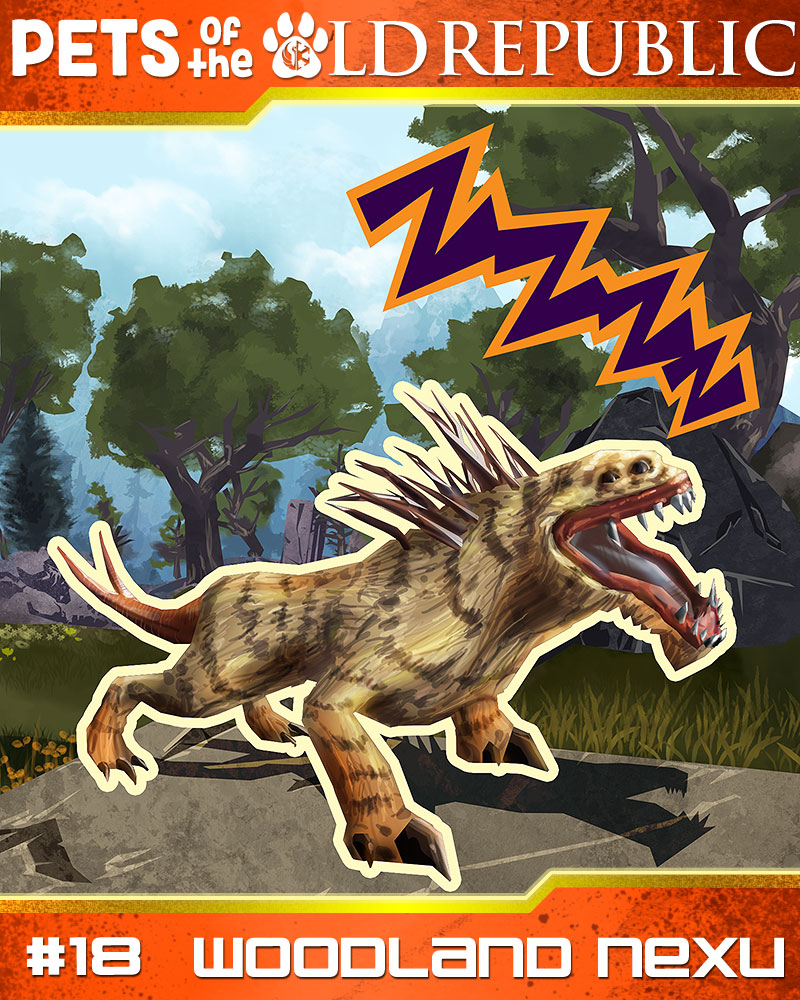
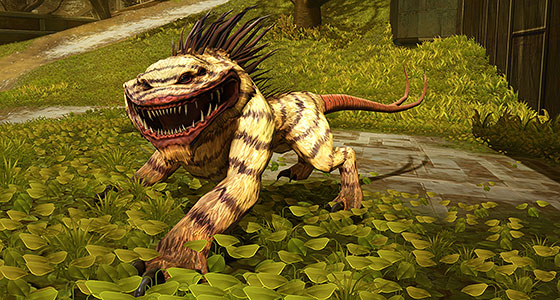
Pets of the Old Republic: #18: Woodland Nexu

The Nexu was one of the most highly requested pets for me to include in the project. The subject of this installment is the Woodland Nexu. There are several varieties of Nexu pets available in Star Wars: The Old Republic, but with this particular version, I was able to depict one whose source is not the Cartel Market and whose appearance most closely matches the Nexu as it appears in its Star Wars debut in Episode 2: Attack of the Clones. This pet allows me to explore the philosophy behind how the Nexu and many, many other creatures in Star Wars lore are created; we can see how mixing and matching qualities of different animals from our world can lead to fictional creatures whose first impression can tell a viewer all they need to know about the creature.

The Woodland Nexu pet can be purchased from either faction’s Kessan’s Landing reputation vendor at Legend rank for the cool price of 1 million credits. An alternative pet, the Wasteland Nexu is available from the Spoils of War vendor for 75,000 credits and 125 Tech Fragments. There are also a few other Nexu that come from the Cartel Market, but they are from more exotic breeds than the two pets on the vendors. There are also several Nexu mounts, most of which also come from the Cartel Market, but if you participate in the PVP seasons, you can save up Season tokens to purchase one of two distinctive armored Nexu mounts. Finally, if you’d like to fight alongside a Nexu, one is available from the Cartel Market as a creature companion.

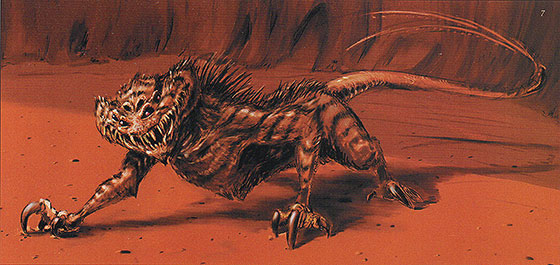
Nexu first appeared in Star Wars in 2002 in the arena melee during the climax of Attack of the Clones. The Nexu was designed by Lucasfilm Concept Sculptor Robert E. Barnes. His initial designs were more lion-like, an appropriate choice given the Nexu was meant to fight our heroes in a colosseum, but he revised the creature when he realized that George Lucas wanted “a feeling, not a literal translation” of the kind of creatures we might expect to see in such an encounter.

Nexu design by Robert E. Barnes from The Art of Star Wars: Episode II – Attack of the Clones.

George Lucas has a design principle that has become known as “The Three Second Rule.” Much of Star Wars’ setting is weird, alien, and fantastic, but it is also grounded enough that it remains familiar to the audience who ought to be able to “connect right away” with its vehicles, creatures, and strange technology as soon as it appears on screen. “The designs have to live by themselves” without explanation. And in that regard, Barnes’ Nexu succeeds brilliantly. It’s not meant to be just an alien lion; it’s meant to be a fearsome and disturbing predator.

Barnes described the Nexu as a “mutated hybrid” and it certainly is that. Nexu have the toothy maw of a shark, the four eyes of a jumping spider, the pelt and stripes of a jungle cat, the claws of a velociraptor, the spines of a porcupine, the forelimbs of a primate, and a long split, rat-like tail. Look, I’m a cat person, but there is nothing adorable about the Nexu. This isn’t a fuzzy house cat or lazy space-tiger, it is every inch a nightmarish predator. You won’t need three seconds to realize that.

On the irradiated jungle world of Taris, this full grown, wild Nexu smiles for the camera.

I think this design explains why the Nexu is so distinctive that it has reappeared often throughout Star Wars lore. It can be seen on screen in the Bad Batch and, of course, throughout Star Wars: The Old Republic. Players will encounter Nexu early on Taris, but they also show up on Voss, Corellia and Nathema.

Nexu are said to be trainable so perhaps a domesticated Woodland Nexu kitten won’t chew off your face, but be careful when you sleep because it may just go for your toes when you least expect it!


1 Comment

Filed under General Star Wars, General SWTOR, My Artwork, Pets of the Old Republic

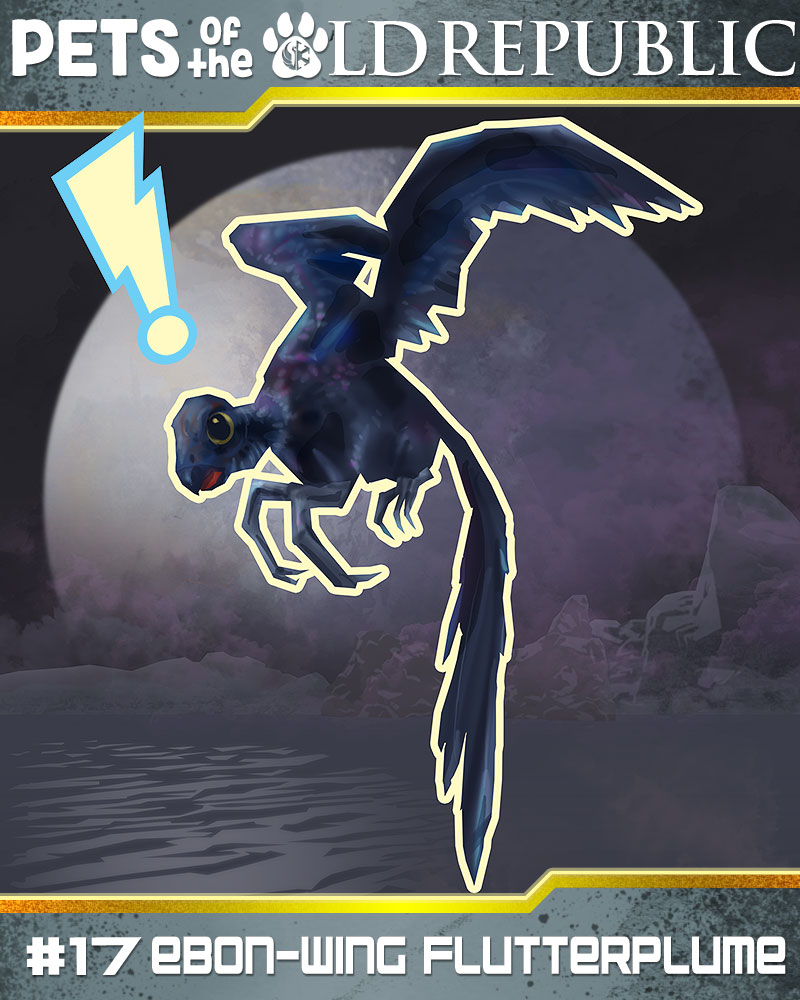
Pets of the Old Republic: #17: Ebon-Wing Flutterplume

For the next installment of Pets of the Old Republic, let’s continue the theme of featuring flying pets, but this time the pet is really is a bird whose flight is powered by actual wings. The Ebon-Wing Flutterplume is one of several Flutterplume pets available in Star Wars: The Old Republic. Flutterplumes are famous for their vibrant and colorful feathers which are regarded as good luck charms, but I’ve chosen to depict a sub-species of the Flutterplume with rather a more raven-like plumage.

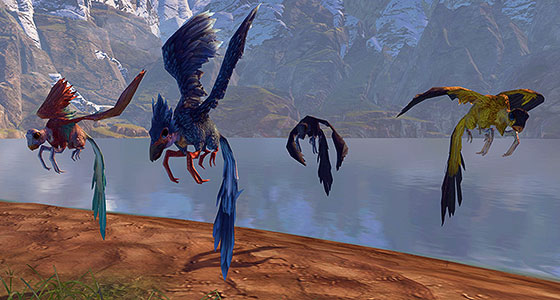
Flutterplumes first appeared in the Star Wars novel Young Jedi Knights: Return to Ord Mantell by Kevin J. Anderson and Rebecca Moesta in 1998, but their first visual depiction was in Star Wars: The Old Republic, and they have featured across the game’s history. Flutterplumes originated on Old Mantell where they thrive thanks to the bloody, ongoing civil war and they have spread across the galaxy to other worlds including several we can visit such as Alderaan, Corellia, and even Rakata Prime. Four of the five Flutterplume pets players can acquire in SWTOR originated from the Cartel Market, but unlike other Cartel pets, I’ve featured in this project, Flutterplume pets tend to be more affordably priced on the game’s auction house. Sadly, the most colorful version, the Gilded Flutterplume, was included with the purchase of Cartel Coins, but since Cartel Coins are now sold directly by SWTOR or through Steam, the Gilded Flutterplume is no longer available to players. The Stormcloud Flutterplume does share an identical model with its gilded counterpart.

Paradise, Stormcloud, Ebon-Wing and Hinterland Flutterplume pets search for buried treasure on the beaches of Copero.

The other three varieties, the Ebon-Wing, Hinterland and Paradise Flutterplumes seem to derive from different species. The Stormcloud has a slightly larger head, and a longer, more vulture-like beak which makes sense given that Flutterplumes are mostly known as scavengers. The Ebon-Winged Flutterplume. as well as its Hinterland and Paradise cousins have heads and beaks that evoke Earth-born parrots. It’s because of that similarity that I’ve chosen this particular Flutterplume.

Birds have long associations with stories of sailors and ships at sea, arguably going all the way back to humanity’s very first stories of the flood in the Bible and other foundational myths including the Epic of Gilgamesh. In more recent times, there seems to be some truth to the association of sailors and pirates with parrots, which are hearty pets that required minimal feeding (compared to other animals) and when returning to their home ports, the sailors could sell the tropical birds to landlubbers who’d never seen such colorful creatures.

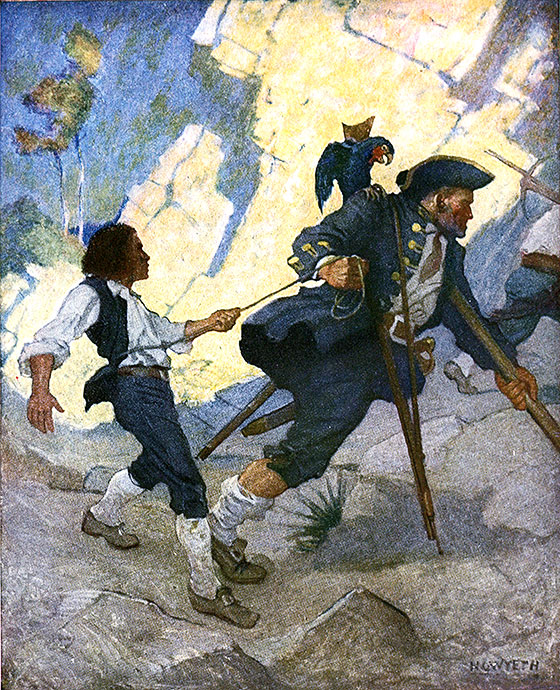
Jim Hawkins, Long John Silver and his parrot Captain Flint from the illustrated edition of Robert Louis Stevenson’s Treasure Island by N. C. Wyeth.

In 1883 Parrots became inextricably linked with tales of pirates on the high seas thanks in large part to Robert Louis Stevenson’s book Treasure Island; a few decades later in 1950 Walt Disney adapted the book for the cinema, and Robert Newton’s depiction of Long John Silver is so iconic that it continues to influence nearly every depiction of pirates in popular culture like the movies Pirates Of the Caribbean and The Goonies  to TVs show like Black Sails and Our Flag Means Death to even the pirates we see in Star Wars lore including Hondo Ohnaka from The Clone Wars and Rebels, and the whole of Skeleton Crew.

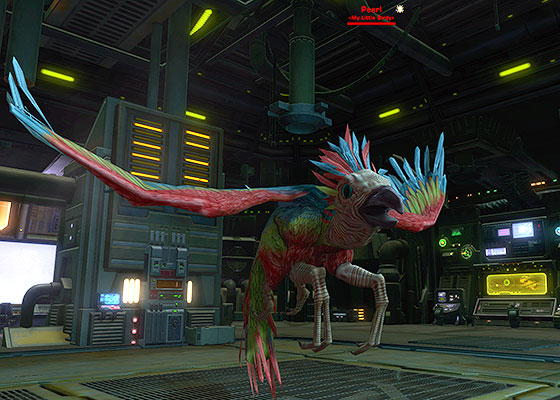
Coratanni’s Flutterplume Pearl is the only raid operation boss described as a “little birdy.”

The two most prominent Flutterplumes in SWTOR are also related to pirates. Pearl, the beloved pet of Coratanni, leader of the Ravagers pirate crew is a raid boss in her own right. Curious players can also encounter Polly the Flutterplume on Dantooine during the Pirate Incursion event. I won’t spoil what happens when you get too close to her, but when you show up on her small island without a cracker, her reaction is quite explosive.

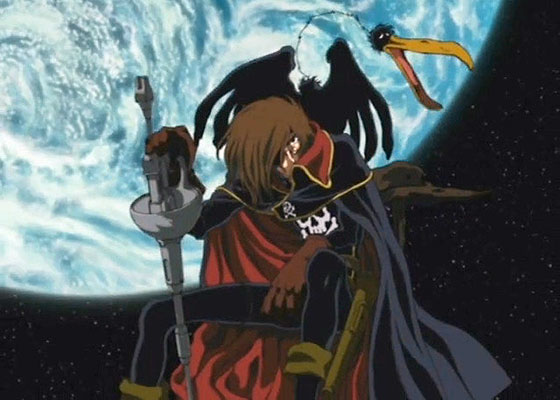
Captain Harlock is brooding, stylish and taciturn; Tori-san is annoying, gangly and loudly opinionated. They’re perfect friends.

Finally, I should confess that the reason I specifically chose to depict the Ebon-Wing Flutterplume is because of its similarity to “Tori-san” or “Mr. Bird” the fine feathered companion of Captain Harlock, my favorite space pirate of all time. Like many of the creatures we encounter in Star Wars, Tori-san draws inspiration from several types of birds including parrots, cranes and parrots. Harlock was created by Leiji Matsumoto in 1977 and has featured in many manga and anime series well into the twenty-first century. Harlock is a beloved and iconic character and has influenced many writers and artists over the years. Jo Duffy who wrote Star Wars stories for Marvel Comics in the 1980s included a direct reference to Harlock in her own tales of a galaxy far, far away.

For my part, the black and white, French language dub of Space Pirate Captain Harlock which was shown on TV in Quebec, Canada was my very first exposure to anime and the show’s entire aesthetic holds a fond place in my heart to this day.


Comments Off on Pets of the Old Republic: #17: Ebon-Wing Flutterplume

Filed under General Star Wars, General SWTOR, Pets of the Old Republic

Pets of the Old Republic: #16: Mischievous Miniprobe

With the Nar Shaddaa Nightlife Event back in full swing, I figured a trip to the Smuggler’s Moon would be appropriate for the next installment of Pets of the Old Republic. The Mischievous Miniprobe feels like the best pet to have out when trying your luck (or lack thereof) at the slot machines.

This is the second droid I’ve featured in this project, and it is one of the most unique pets in all of the game. The Mischievous Miniprobe flies and beeps alongside you, and it will occasionally open up to spray you with sparkles and confetti. This miniprobe’s programming is clearly meant to remind you not to take yourself too seriously.

The original source of this pet is the Cartel Market, but it is currently not available for purchase, and at least on Star Forge, it will cost you many, many pretty pennies to buy from the auction house of the Galactic Trade Network. This is such a delightful and unique pet, that I hope that it might find its way back to affordable sale one day.

If a droid floats in a Star Wars movie, it’s probably evil.

Floating droids of this type go back to the earliest days of Star Wars, as seen by the Interrogation Droid in A New Hope and the Imperial Probe Droid from The Empire Strikes Back.

Miniprobes both in Star Wars lore and SWTOR tend to favor a spherical construction, so the Mischievous Miniprobe’s design is unusual in its class. Shintar remarked that this pet reminded her of an old school telephone receiver, but I would not suggest putting this droid up to your ear lest you want a face full of confetti!

“Non sequitur. Your facts are uncoordinated…”

I don’t know if it’s intentional, but the robot that Mischievous Miniprobe first brought to my mind was the space probe Nomad from the original Star Trek episode “The Changeling.” Both robots float, have long central “torsos” and antennas atop their heads. The head of the Miniprobe recalls the T-series astromechs that are common in the Old Republic, but Nomad’s low-budget 1960’s aesthetic doesn’t feel too far off from Star Wars’ 1970s style. Attach some spindly robot arms and legs to Nomad and you’ve practically got IG-88!

Regardless, a Mischievous Miniprobe is not likely to threaten the lives of the crew of any starship in a galaxy far, far away, but someone with an electro-mop may have to clean up the literal mess it leaves in its wake!

Within SWTOR lore, the only other droids that seem to have a similar structure are the Iokath Technolith remotes. We have encountered Zakuulan gods of rage, passion, envy, apathy, sorrow and death. I am certainly drawing together the most narrow of threads, but perhaps the Mischievous Miniprobe was created by or in tribute to an unseen trickster god from the Machine God pantheon. I would not be shocked to learn that even on Iokath there was a place for their version of the Coyote spirit or Loki.

This miniprobe does not seem like one that fancies mischief.

If you’ve been following my Pets of the Old Republic project, you may have noticed that I’ve fallen a bit behind lately. This summer I have had opportunities to spend more time with family and friends, and something had to give. It’s unlikely that I will finish this series when I’d originally intended, but I promise I will finish it! I received so many great suggestions for pets to feature that I fully intend to cover them all.

And maybe this will give Broadsword time to finally slip a Porg into SWTOR


4 Comments

Filed under General Star Wars, General SWTOR, My Artwork, Pets of the Old Republic